
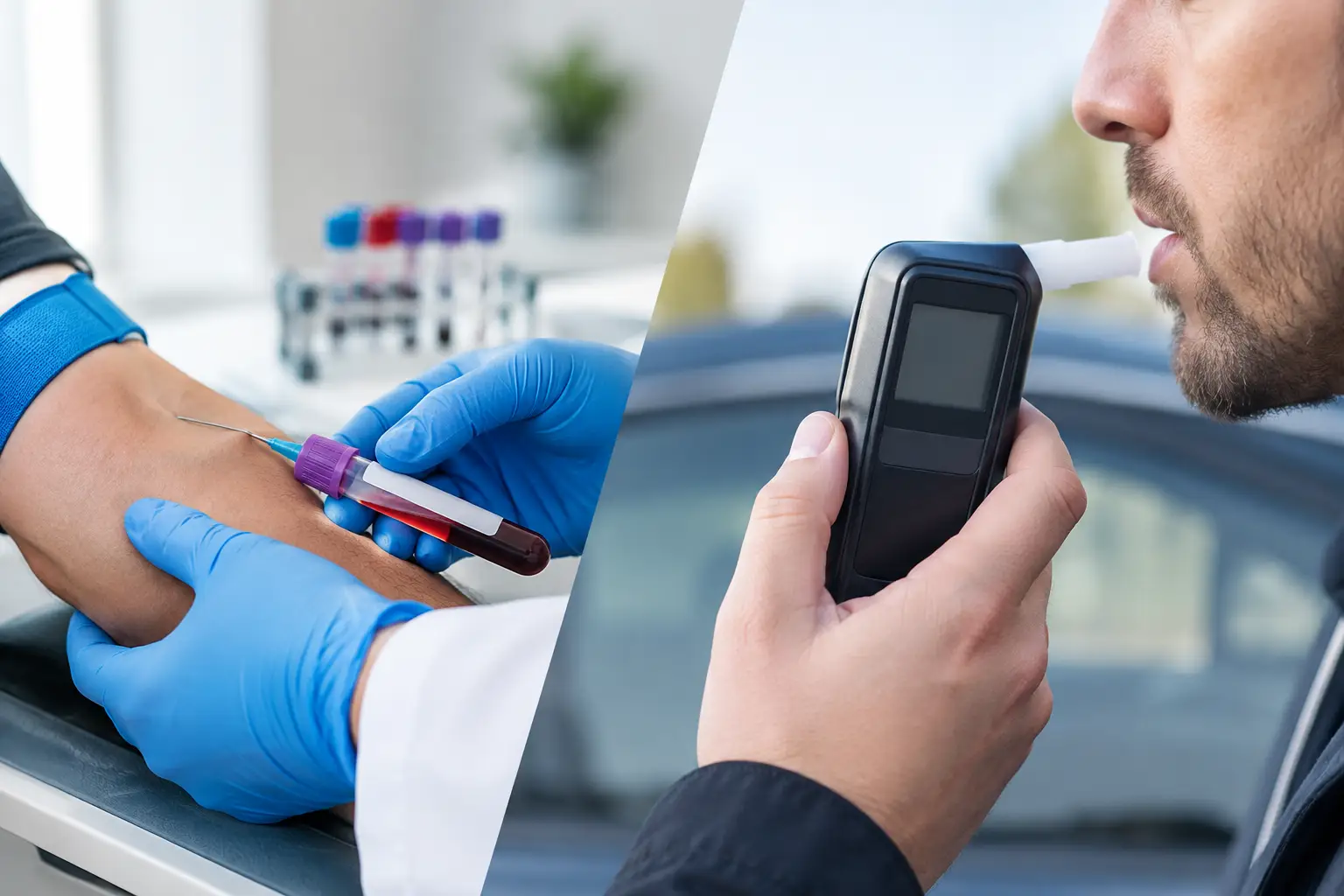
A blood test versus breathalyzer result can become the center of a California DUI case within hours of an arrest. Yet neither number tells the whole story by itself. The device, the officer’s instructions, the timing of the test, the laboratory process, and the person’s alcohol absorption all matter. When your license, freedom, career, and reputation are at risk, the prosecution’s test result must be examined, not simply accepted.
Blood Test Versus Breathalyzer: What Is the Difference?
A breathalyzer does not directly test the alcohol concentration in your blood. It measures alcohol in deep-lung breath and uses a mathematical conversion to estimate blood alcohol concentration, or BAC. California law permits breath testing for evidentiary DUI purposes, but the result depends on the machine functioning properly and the test being administered under required procedures.
A blood test, by contrast, requires a blood draw followed by laboratory analysis. The sample is typically tested for alcohol and may also be tested for drugs. Because blood is a bodily sample, prosecutors often portray it as more definitive than a breath result. That does not make it beyond challenge.
Both methods can produce evidence the prosecution will use aggressively. Both can also reveal weaknesses that a disciplined DUI defense can expose.
The First Critical Distinction: PAS Tests and Chemical Tests
Many DUI cases involve more than one breath test. The test given roadside before an arrest is often a preliminary alcohol screening test, commonly called a PAS test. For many drivers age 21 or older, this pre-arrest test is generally voluntary. An officer may not always explain that distinction clearly in a stressful roadside encounter.
After a lawful DUI arrest, California’s implied-consent law generally requires a person to submit to a chemical test of breath or blood. Refusing a required post-arrest test can lead to serious consequences, including added license penalties and enhanced punishment allegations. The precise options available can depend on the circumstances, including whether drugs are suspected and whether a breath test is available.
This sequence matters. A prosecutor may rely on observations from the traffic stop, field sobriety exercises, a PAS reading, and a later evidentiary test. A defense attorney should assess each stage independently. A poor roadside investigation does not become reliable merely because a later test produced a number.
Why Breathalyzer Results Can Be Wrong or Misleading
Breath testing is fast and common. It is also vulnerable to human and mechanical error. Before accepting a breath result, the defense should ask whether the officer followed the required observation period, whether the machine was properly maintained, and whether the test samples were consistent.
The required observation period is not a meaningless formality. The officer should watch the person before testing to help ensure that no alcohol, food, vomit, smoke, or foreign substance affects the reading. Residual alcohol in the mouth can create an artificially high result. A rushed, interrupted, or poorly documented observation period may matter significantly.
Breath instruments also rely on assumptions that do not fit every person perfectly. The machine estimates BAC from breath alcohol using a standardized ratio. Individual physiology, body temperature, breathing pattern, and certain medical conditions can affect how breath alcohol relates to alcohol in the bloodstream.
Timing can be equally important. Alcohol is not absorbed at the same rate throughout the night. If someone was stopped shortly after drinking, their BAC may have continued rising after they were driving. That is often called a rising BAC issue. The test result obtained later at the station may not accurately establish BAC at the time of driving.
A valid defense does not rest on vague claims that breath tests are “always inaccurate.” It identifies a specific problem in the evidence, then connects that problem to what the prosecution must prove beyond a reasonable doubt.
Blood Tests Have Their Own Vulnerabilities
Blood testing removes some breath-specific issues, but it creates a separate chain of questions. Who drew the blood? Was the draw performed lawfully? Was the sample properly labeled, preserved, stored, transported, and tested? Can the laboratory show an unbroken chain of custody?
A blood sample can be affected by contamination, improper handling, inadequate preservative, fermentation, or analytical error. Small mistakes at collection can follow the sample into the lab. So can documentation gaps. If the state cannot reliably establish that the tested vial belonged to the accused driver and remained properly handled, the reported result deserves close scrutiny.
Laboratory testing also involves equipment, calibration records, quality-control procedures, and analyst judgment. Those records are not background paperwork. They may be central to determining whether the reported BAC is scientifically reliable.
Blood draws raise constitutional issues as well. The government’s ability to take and test blood is subject to legal limits. Whether consent was valid, whether a warrant was obtained when required, and whether an exception applied can affect whether the results may be used in court.
Which Test Is Stronger in a California DUI Case?
There is no automatic winner. A properly collected and reliably tested blood sample may give the prosecution powerful evidence. But a blood result can be weakened by collection errors, custody failures, lab issues, or an unlawful search.
A breath test avoids many of the handling issues involved in blood testing, but it is an estimate rather than a direct blood measurement. It may be especially vulnerable when officers did not follow protocol, the person had a potential mouth-alcohol issue, or the timing points to rising BAC.
The stronger case is the one supported by trustworthy evidence from beginning to end. Prosecutors still must prove that the driver was under the influence or drove with an unlawful BAC. A number printed on a report is evidence. It is not a verdict.
What Prosecutors Look for and What Defense Counsel Should Investigate
The state will try to build a complete narrative: the driving pattern, the officer’s observations, statements made during the stop, field sobriety exercises, body-camera footage, and chemical test result. As a former prosecutor, Polina Logrue understands how that narrative is assembled and where it can break down.
A serious defense investigation may examine whether the initial stop was legal, whether the officer had grounds to continue the detention, and whether the arrest was supported by probable cause. It should also obtain the breath-testing records or blood-lab materials, review video evidence, compare timestamps, and evaluate whether the BAC result aligns with the actual drinking timeline.
This work can expose facts the arrest report leaves out. Video may contradict claims of poor balance or slurred speech. Dispatch records may show delays that support a rising BAC defense. Machine records may reveal compliance problems. A lab packet may raise questions that are invisible in a one-page arrest report.
Do Not Wait for the DUI Case to Move on Its Own
A DUI arrest can trigger two urgent fights: the criminal case and the action against your driving privilege. Deadlines can arrive quickly, and evidence can become harder to obtain with time. Waiting to see what happens gives the prosecution a head start.
Do not try to explain away the case in a casual call with law enforcement, post details online, or assume that a test result means there is no defense. Preserve any paperwork you received, write down what you remember about the stop and testing, and seek legal guidance promptly.
The right response depends on the evidence, the timeline, and the stakes you face. But one principle is consistent: a blood or breath result should be tested as hard as the prosecution intends to use it against you. Fast, strategic action can protect far more than a driver’s license. It can protect the future attached to your name.